

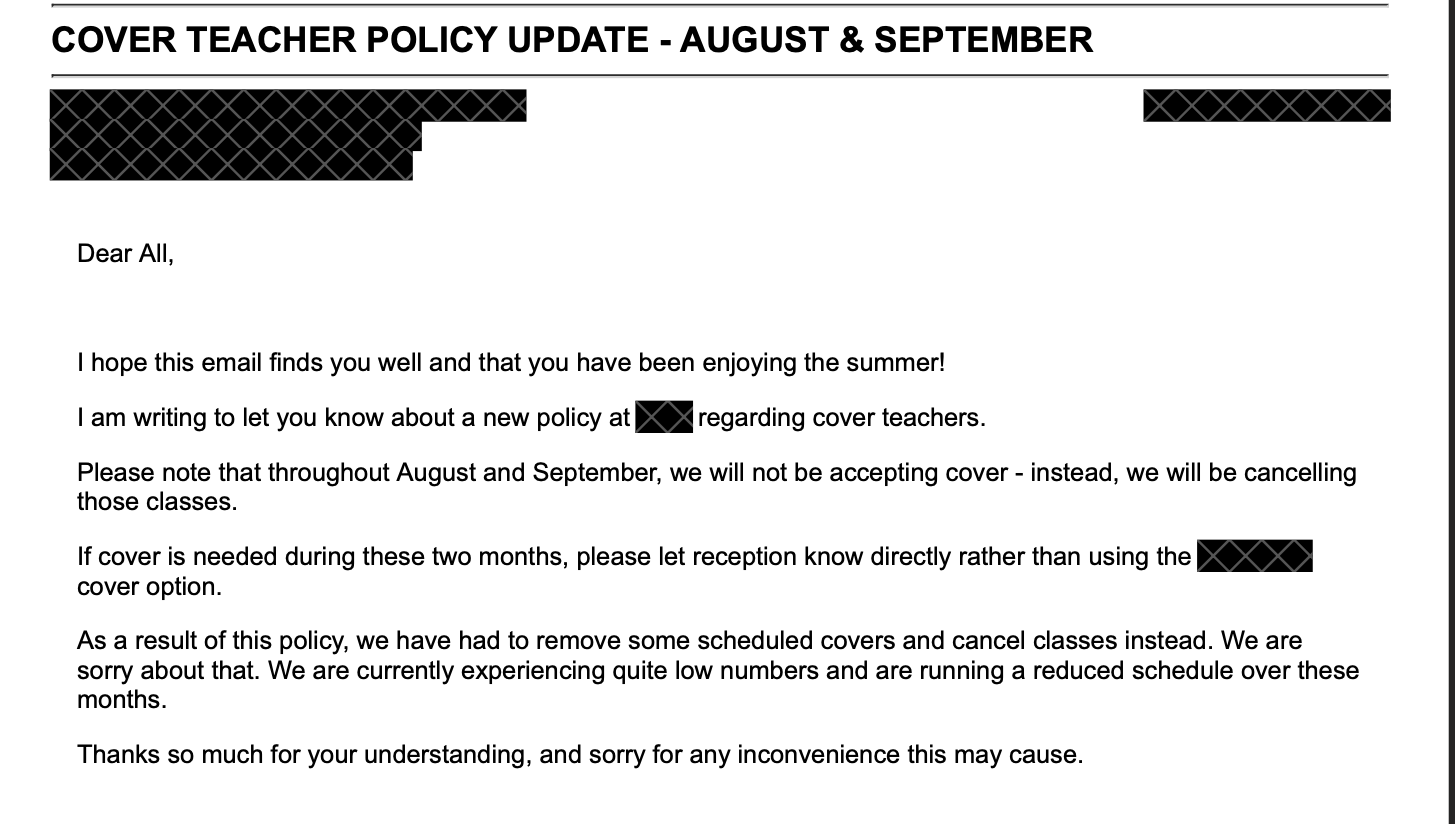
COVER TEACHER POLICY UPDATE — AUGUST & SEPTEMBER. Bold caps that somehow still manage to sound gentle.
The message itself is short. Throughout August and September, the studio will no longer be accepting cover for classes. Instead, those classes will simply be cancelled. If a teacher needs cover during this period, they’re asked to contact reception directly rather than use the usual system. The studio notes it has already had to remove some scheduled covers and cancel classes as a result, attributes this to “quite low numbers,” and signs off with the customary apology for any inconvenience caused.
Any inconvenience this may cause. It’s the kind of sentence built to be unobjectionable, not rude, not dismissive, even performing a certain care. But it’s also doing something subtle beneath the surface. It reframes a structural decision, the studio choosing not to pay for cover, and therefore choosing to cancel classes rather than absorb that cost, as a minor, incidental disruption. Not a policy that removes a source of income from teachers who were already living without guaranteed numbers but also taking classes away from members who are around to continue attending their regular classes.
Let me be concrete about what “cover” actually is, because the word itself is obscure if you’re not a yoga or fitness teacher. Cover, for a lot of teachers, is the difference between a stable month and an unstable one. It’s a way of picking up an extra class when a regular slot falls through, or when income from private clients takes a hit, which it does, sometimes without warning. Losing the option of cover doesn’t just mean one class disappears. It means a whole category of income, the flexible, fill the gaps kind that self-employed teachers rely on precisely because nothing else about this work is guaranteed, gets closed off for an entire season.
Do the arithmetic, even loosely. A cover class might be worth £35 to £60 to the teacher covering it. Multiply that across two months, across however many teachers were relying on that studio for cover shifts, and you’re not looking at an inconvenience. You’re looking at a few hundred pounds per teacher, disappearing without negotiation, justified by three words: quite low numbers.
Low numbers for whom? Not the teachers, who now have less work. The studio’s numbers are down; the teachers’ income is what actually absorbs it.
Two weeks ago I wrote about summer as a structural feature of yoga teaching’s precarity. Not a blip, but a predictable seasonal cliff that studios rely on teachers to simply absorb. This email is the same pattern wearing different words. Not new information so much as confirmation, arriving with almost comic timing, as if the industry wanted to make sure the piece had a sequel.
I’m not naming the studio. That’s not the point. The point is that this is a system, and systems don’t apologise once. They apologise on a rolling basis, studio by studio, email by email, always in the same register; warm, regretful, entirely unaccountable to the people actually losing income and the teachers just have to swallow it with an Om Shanti Shanti. I think of another studio that closed with three days’ notice, not long ago. The message was warm too: we’ve sold the business, it was great working with you. Three. Days. Notice. Thirty-odd teachers left without classes, wrapped in the same kind, unaccountable language. I’m sure the owner was heartbroken you don’t want to lose a studio you’ve poured your sweat into, I know its a labour of the soul to run spiritual spaces; but the apology costs the studio nothing. It’s the teachers who pay. It’s the teachers who built classes from scratch with focussed dedication often for very little renumeration.
I wonder what the answer is to this dilemma.
If you’re a teacher who’s had classes cancelled like this over the summer, I’d genuinely like to hear from you. It’s easy to feel like this is happening to you alone. It usually isn’t.